The Foundational Narrative
"If you can keep your head when all about you / Are losing theirs and blaming it on you..."
— Rudyard Kipling, If—
A Note on This Chapter
Everything begins here.
Before argument. Before irony. Before fragmentation and subtext and unreliable narrators.
Before all of that: the world. As it actually is. The weight of it. The texture of it. The people in it who work and suffer and survive and don't explain themselves.
Chapter One teaches you one thing: how to look.
Not what to feel. Not what to conclude before you have looked. First, how to look — at a physical object, at a face, at a landscape, at a moment — and describe what is actually there without decoration, sentimentality, or the distortion that comes from wanting the world to confirm what you already believe.
The three writers in this chapter built their careers on looking. Kipling looked at an empire with love and clear eyes and described both the beauty and the damage, without fully resolving the contradiction. Buck wrote about an old woman who will not look out of her window, and about the day she does. Steinbeck wrote about a woman who looks at a stranger across a fence, and who at the end turns her head so that she will not see.
They are very different writers. They agree on one thing: the world outside your own experience deserves exact, patient attention — and that attention is the beginning of writing.
Before We Begin
Do not describe what these objects mean. Describe what they look like.
- A pair of hands that have worked outside for thirty years.
- A road that goes through flat land toward a horizon you cannot reach.
- A child's face watching something it does not understand.
Do this: Write three sentences — one for each object. No adjectives that describe feelings. No statements about what the object represents. Only what is there.
(You will return to these sentences at the end of the chapter and read them with new eyes.)
Part One — Kipling
Nobel Prize in Literature 1907. See Gallery for the full biographical entry.
A — Context for This Chapter
Rudyard Kipling was born in Bombay in 1865, sent to England at the age of six, and spent the rest of his life writing his way back to a country that was never quite his to keep. What does it mean to love a place and rule it at the same time? Kipling never answered that question. He never stopped asking it either.
He is the great poet of the empire. The White Man's Burden. Send forth the best ye breed. The idea that ruling other people was a duty, even a kindness — and we are not going to pretend he didn't mean it. He looked at India with real love and real precision, and he looked at it as a man who believed the British belonged on top. Both things are true at once, and the contradiction does not dissolve no matter how long you stare at it. Hold it open. That is the work.
But the contradiction is only one reason to read him. The other reason is range. Kipling was not one kind of writer. He wrote children's stories: Just So Stories (1902), where the elephant gets its trunk and the leopard gets its spots, told with a sly comic voice that sounds like someone making things up on the spot for a child who is far too sharp to be fooled. He wrote Kim (1901), a novel about an orphan boy, Irish by blood and Indian by upbringing, who moves through India as a spy, shifting identities, belonging nowhere and everywhere — one of the strangest and most alive picaresque novels in English. He wrote If— (1910), which you have already read because it opens this chapter: thirty-two lines that have been printed on more motivational posters than any other poem in the language, and which are genuinely good despite that. He wrote stories about soldiers in the mud, engineers building bridges across rivers, clerks dying of fever at their posts. He wrote about the sea and the jungle and the barrack-room and the machinery rooms of steamships.
What connects all of it? Attention. Kipling looks. He looks at the specific weight of a rope, the particular smell of an Indian summer night, the way a cobra moves when it is building to a strike. He does not describe feelings and call them objects. He finds the object and trusts you to feel it yourself. That looking — patient, exact, ahead of any judgement — is the skill the whole first year stands on. Chapter One begins here because Kipling earns it.
He received the Nobel Prize in 1907, the first writer in English to win it and, still, the youngest ever to do so.
B — The Story: Rikki-Tikki-Tavi
Source: Rudyard Kipling, Rikki-Tikki-Tavi, from The Jungle Book (1894). Public domain — the full text is here: read Rikki-Tikki-Tavi. The paragraphs there are numbered, so §42 means the same sentence for everyone, on paper or on a screen.
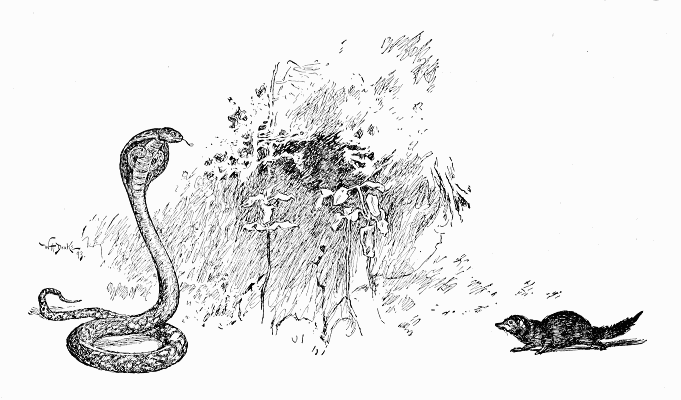
A flood washes a young mongoose out of his burrow and leaves him half-drowned on the path of an English family's bungalow in India. They dry him; he stays. In the garden live two cobras, Nag and Nagaina, who have killed before and mean to go on killing. Rikki-tikki fights them — single-handed, through the bathrooms of the big bungalow — and saves the family. Read it once and it is one of the best adventure stories ever written. Read it twice and it is a story about who a garden belongs to.
This is not the only Kipling you will meet, but it is the right place to start. Rikki-Tikki-Tavi is short enough to read in a single sitting and precise enough to reward careful study. And the question it quietly carries — whose side are you on, and why does that seem so obvious? — is the question that runs through all three parts of this chapter.
Do this before you read: Kipling is teaching you how to look at a living thing. Go slowly through §2, the description of the mongoose, before any danger starts. Notice exactly what he notices.
Then: Read the story.
B1
Before the plot moves an inch, Kipling builds the mongoose in front of you — and one sentence in that paragraph carries more than you will see on a first read.
Do this:
- Read the first sentence of §2 aloud.
- Write in one sentence: which parts of Rikki are like a cat, and which are like a weasel?
- Write in one sentence: where does a cat live, and where does a weasel live?
- Write in one sentence: is Rikki a tame animal or a wild one?
- Write in one sentence: what does the family in the house need him to be?
B2
Nag and Nagaina are the enemy — and yet Kipling gives them voices, fear, and a reason: they were "king and queen of the garden" before the people came, and they want it back for their own children.
Do this:
- Find the moment Nagaina explains why the family must die. Write down its § number.
- Write in two sentences: is she wrong? Say why.
- Write in one sentence: what becomes less simple when the enemy makes sense?
B3
Why does Rikki-tikki fight? Nobody asks him to kill three snakes, and he nearly dies twice doing it.
Do this:
- Find two places where the story tells you why Rikki fights. Write down their § numbers.
- Write in one sentence for each: what reason does that § give?
- Write in two sentences: which reason does the story believe most? Say why.
C — Close Reading: The Exact Animal
C1 — Looking before judging.
This is the same muscle you used on your three objects at the start of the chapter — Kipling is just stronger at it.
Do this: Find five physical details Kipling gives about Rikki-tikki in §1–22, before he meets Nag. For each one, write the detail, its § number, and what it shows about the animal without telling you.
C2 — Who was here first?
Kipling wrote this story in 1893. Britain ruled India. The family in the story is English, and the story is told from their side.
Do this:
- §6. Who has just moved into the bungalow? Write it down.
- §17. Rikki-tikki's mother lived in "the General's house". Write what a general is. Then write who the "white men" are.
- §24. Nag says a god put a mark on his people. Write the god's name, and the country that god belongs to.
- §52–54. What do Nag and Nagaina want? Copy one sentence. Then write who lived in the garden first: the family or the snakes.
- Read this: The story is about a mongoose and snakes. It is also about who rules India. The English are new in the house. The snakes were there before them. Rikki-tikki fights for the English. True or false? Write one sentence, with a §.
- Say it aloud — don't write it. Whose garden is it?
C3 — The fight in the bath-room.
C1 asked what Kipling sees. This one asks how he writes it: how fast the sentences move.
Do this:
- Read §59–61 aloud in pairs, one paragraph each.
- §59. Find two phrases built the same way: ___ by ___. Write them down.
- §61. Find the shortest sentence. Write it and count the words.
- §61. Find the long sentence that begins "Then he was battered…". List everything that gets knocked over or banged.
- Write in two sentences: what does the short sentence do to you as a reader? What does the long one do?
C4 — Love and the contradiction.
Kipling plainly loves this world: the garden, the animals, the boy with the mongoose asleep on his pillow. He also believed empire was a duty. The word respect comes from the Latin for looking back, looking again — and the whole story turns on quickness of eye, on who manages to see whom in time. So look again. Can a story be tender, exact, beautifully observed — and carry an empire's assumptions inside it at the very same time?
Do this: Write the beginning of your answer to that question: three to five sentences, with one place in the story as evidence (§).
Part Two — Buck
Nobel Prize in Literature 1938. See Gallery for the full biographical entry.
A — Context for This Chapter
Pearl Buck grew up in China. Her parents were missionaries. She learned Chinese before she learned English. She played in the same streets, ate the same food, and lived among the same people whose lives she would later describe in her novels.
She made her name with The Good Earth (1931), a novel about a Chinese farmer and his land, and in 1938 she became the first American woman to win the Nobel Prize, "for her rich and truly epic descriptions of peasant life in China". But the story you are going to read is not set in China. It is set in New York — and that is not an accident. In 1934 Buck left China for good. After the revolution of 1949 the new government would not let her back in, and it never did. The woman who had written China for the whole English-speaking world spent the rest of her life remembering a country she could not return to.
So did thousands of others. In 1949 the Communists won China's civil war, and in the years that followed, landowners and their families were hunted down in their own villages. Old Mrs. Pan, the widow of a landowner, has been rescued by her son and carried across the Pacific to New York's Chinatown. She is safe. She is also dying — not of illness, but of uselessness.
What do you do with a person nobody needs? That is the question Buck asks, twice, about two women. Her answer is a comedy.
The title is worth a moment. A deed is simply a thing done — the word is a close relative of do. Not a thing felt, not a thing meant: done. Like Kipling's mongoose, Buck's people are what they do.
B — The Story: "The Good Deed"
Source: Pearl S. Buck, "The Good Deed" (1953). The full story is in your text booklet — on paper only, because it is still in copyright. The paragraphs are numbered, so §73 means the same sentence for everyone.
Mr. Pan has saved his mother's life and cannot make her want it. She will not eat. She cannot tell the hot tap from the cold. She sits all day where she cannot see out. In desperation his wife calls a friend, Lili Yang — a social worker who speaks Chinese, twenty-seven years old and unmarried. Mrs. Pan is horrified. In this barbarous country, it seems, nobody arranges anything. So she decides to arrange it herself. Read it once and it is a comedy about a meddling old woman. Read it twice and it is a story about a woman who learns to look out of the window.
Buck is quieter than Kipling. She does not build a creature in front of you; she lets you sit in a room with one.
Do this while you read: Watch the window. Every time someone looks out of it — or refuses to — make a mark in the margin.
Do this: Read the story.
B1
Buck names Mrs. Pan's feelings only once or twice (haunted with homesickness, §4; lonely, §15). Most of the time she gives you things instead — and there are more of them than you will notice on a first read (§7–16).
Do this:
- List every such thing you can find. Write the § number beside each.
- Write beside each one what it shows that she was homesick cannot.
B2
In §71 Mrs. Pan studies Lili's face: "This was not a pretty girl." In §167 James Lim looks at the same face and thinks the old woman "had not done her justice".
Do this:
- Put the two looks side by side. Write what each one sees, and what each wants while looking.
- Write in one sentence: is anyone in this story interested in what Lili sees?
B3
The title says the good deed, as if there were only one.
Do this:
- Find every good deed in the story — there are at least four. Write the § number beside each.
- Choose the one you think is the good deed. Write in one sentence why.
- Write in two sentences: is arranging another person's marriage a good deed at all — or does it depend on where you stand?
C — Close Reading: The Window
C1 — The inventory of a room.
Do this:
- Find five objects in Mrs. Pan's room or the apartment around her. Write the § number beside each.
- For each one, write the object, and what the way Buck places it shows about the woman who owns it or refuses it.
- Take out your three sentences from the start of the chapter. Write in one sentence: what did Buck do with her objects that you did not do with yours?
C2 — The window.
Mrs. Pan sits "where she could not see out". Later she gazes into the street "really for the first time since she came". Later still she crosses that street with her eyes shut tight; then she crosses it back, and "this time she did not shut her eyes". Buck never tells you what changed inside her.
Do this:
- Find these four moments in the story, in order. Write the § number beside each.
- Write in three sentences: describe the change yourself — using only what she does.
C3 — Two languages in one room.
Mrs. Pan speaks no English. When her son and his wife quarrel in English (§113), she understands only that there is a quarrel. When the young people talk in English at the tea table (§168), she watches them and thinks: "So this was the way it was." A woman who cannot follow the words has to read the faces — the way Kipling reads a mongoose.
Do this:
- Find one moment where Mrs. Pan reads a situation correctly without understanding a word of it. Write down its § number.
- Write in two sentences: how does she do it?
C4 — The box and the garden, again.
Go back to Rikki-Tikki-Tavi: a house kept safe by a creature whose purpose is to keep the outside out. Now look at §116. Mrs. Pan asks for her window to be opened — the window she had kept shut "for fear she might be assailed by the foreign winds". Kipling's story protects a house from the world outside it. What does Buck's story do with the world outside? Notice also what Nagaina and Mrs. Pan have in common: both have lost a home to strangers (§26). Nagaina fights to get hers back.
Do this:
- Write in one sentence: what does Buck's story do with the world outside?
- Write in one sentence: what does Mrs. Pan do instead of fighting?
- Write in two sentences: how far does the comparison hold — and where does it break?
Part Three — Steinbeck
Nobel Prize in Literature 1962. See Gallery for the full biographical entry.
A — Context for This Chapter
John Steinbeck grew up in the Salinas Valley of California and worked on its ranches before he became a writer. He knew what physical work felt like in the body — and he knew the valley the way you know the street you grew up on: every fence, every road along the river, every kind of weather.
He is most famous for The Grapes of Wrath (1939), about a family driven off their farm by drought and poverty. He received the Nobel Prize in 1962, "for his realistic and imaginative writings, combining as they do sympathetic humour and keen social perception". But the story you are going to read has no poverty in it. Elisa Allen and her husband run a working ranch. They have enough. What Elisa does not have is harder to name — and Steinbeck, famously, never names it.
"The Chrysanthemums" was first published in 1937 and collected a year later in The Long Valley. It is set on a single December afternoon, in the valley where Steinbeck grew up. Almost nothing happens. Read it slowly anyway.
The flower in the title is worth a moment. Chrysanthemum comes from the Greek chrysos, gold, and anthemon, flower: the golden flower. Elisa grows hers enormous, ten inches across, bigger than anybody around. Watch how the people in the story describe them — and what each description is for.
B — The Story: "The Chrysanthemums"
Source: John Steinbeck, "The Chrysanthemums" (1937). The full story is in your text booklet — on paper only, because it is still in copyright. The paragraphs are numbered.
A December afternoon on a ranch in the Salinas Valley. Elisa Allen, thirty-five, is cutting down last year's chrysanthemum stalks while her husband sells thirty head of cattle to two men in suits. He offers to take her into town for dinner. Then a wagon comes up the river road, driven by a big man who mends pots and sharpens scissors. He is off his road and short of money. She has no work for him — until he asks about her flowers. Read it once and it is a story in which almost nothing happens. Read it twice and it is a story about a woman who is seen, for twenty minutes, and then finds out what that was worth.
The first three paragraphs contain no people at all. Before this chapter is over you will write a paragraph like them yourself.
Do this before you read on: Read them twice, slowly.
Do this: Read the story.
B1
In §1–3 no person appears. Only two words in these paragraphs name a feeling: the farmers are "mildly hopeful", and the air is "cold and tender". One feeling belongs to people. Steinbeck gives the other to the air.
Do this:
- List everything the fog, the plows, the willows and the wind do. Write the § number beside each.
- Write in two sentences: why would a writer this careful break his own rule — and why there?
B2
The man at the fence has come to sell a service. He looks at Elisa, then at the ground, then at the chrysanthemum bed (§51). He calls the flowers "a quick puff of colored smoke", and Elisa answers, "What a nice way to describe them" (§53–54).
Do this:
- Read §92: "Sand, ma'am?... Sand? Oh, sure."
- Write in one sentence: what did he actually see when he looked at the flowers?
- Write in one sentence: is his looking a form of respect, or a form of power?
B3
"Far ahead on the road Elisa saw a dark speck. She knew." (§110) Steinbeck never uses the word chrysanthemums in the rest of the story.
Do this:
- Write in one sentence: what did she know?
- Write in two sentences: how does Steinbeck make sure you know anyway — and what would be lost if he had said it?
C — Close Reading: The Fence
C1 — Looking before judging.
Do this:
- Go through §5–8, before anyone speaks to Elisa. Find five physical details: her clothes, her hands, her tools, her house.
- For each one, write the detail, its § number, and what it shows about her without telling you.
- Steinbeck calls her fingers "terrier fingers" (§8). Write in one sentence: what does a terrier do?
C2 — The fence.
A wire fence "protected her flower garden from cattle and dogs and chickens". Henry leans over it. The stranger draws a finger down it "and made it sing", then comes through into the yard. At the end, Elisa stands in front of it, watching the wagon go.
Do this:
- Map every crossing of the fence: who is inside, who is outside, who is let in, and by whom. Write the § number beside every crossing.
- Say it aloud — don't write it. Kipling's question, asked of this garden too: whose garden is it?
C3 — Two words.
When Henry sees Elisa dressed for town, he has two words for her: nice and strong (§101–104). She throws both back at him.
Do this:
- Write in one sentence: why do two harmless words make her angry?
- Rewrite Henry's line so that he says what he actually sees in front of him — the way Steinbeck would have written it.
C4 — Two women, two crossings.
Old Mrs. Pan crosses a street with her eyes shut and comes back with them open. Elisa, in the car, "swung full around toward her husband so she could not see" — and "She did not look back" (§112–113). One woman learns to look; the other learns not to.
Do this:
- Write in two sentences: what has each of them seen?
- Read the very last words of Steinbeck's story (§124). Write in one sentence: who is the old woman in these two stories — and who is weak?
Do this: Step back across the whole chapter — Kipling, Buck, Steinbeck. Find one technique all three share. Find one thing each of them does that the other two do not. Give a § number for every example.
→ Archive for this chapter: Chapter 1 — respect · detached · peripheral · veranda
The Writing Task
This task is practice, not a test. It is designed to feel achievable and to expose exactly where the difficulty is.
Do this:
- Choose one person from your own life — not a family member — whom you have watched doing something. It could be anyone: a neighbour, a stranger on a bus, someone at work, someone behind a counter. Leave out names, and change any detail that would let a reader recognise them.
- Write 150–200 words describing them doing the thing you watched. The rules:
- No adjectives that describe feelings (kind, cruel, sad, impressive)
- No statements about what the action means ("this showed that...")
- No explanation of why they do what they do
- Only: what they look like, what they do, what they use, what the place looks like
- Read it back. Circle every word that tells the reader what to feel or think. Replace each circled word with a word that shows something physical.
- Read your revised version to a partner. Ask: who is this person? What do you know about them? What do you not know?
What comes next: The writing test at the end of the chapter asks for the same discipline, turned on a place. You will describe somewhere you know before any person enters it — the way Steinbeck opens "The Chrysanthemums" (§1–3).
The Big Question
Kipling. Buck. Steinbeck.
In each of these stories someone looks, and someone is looked at. Who, and from where, is for you to find.
The question underneath all three is bigger than this chapter, and you will not answer it here. You will carry it through the year. In May you will answer it with a passage of your own choosing:
Does it matter where you stand when you look?
Do this: Write down where each of the three writers stands when they look. Not what they believed. Where they stand. Keep it. You will return to it.
Copyright note: Kipling died 1936 — public domain in Sweden and the EU. Buck died 1973 and Steinbeck died 1968 — both still in copyright. Teacher copies of both fall under the school's Bonus Copyright Access agreement (the 15/15 rule). Kipling's works are freely available on Project Gutenberg.